A little Japanese trick for saying ‘no’

People in a small, well-lit Japanese restaurant or bar, with a menu on the wall and beverages on the counter.

As I’ve got older, I’ve got better at saying ‘no’ to requests I don’t fancy, but I regularly fail. Usually, I feel the urge to give a socially acceptable reason – busyness, or a clash. But, without an excuse, sometimes I lie (which feels wrong), or I people-please and agree (which also feels bad… for me).

So, during a recent trip to Japan, I was intrigued to learn a new word for ‘no’. In Japanese, saying chotto is a way of declining without offence. According to the newsletter Japan or Die, chotto translates directly as ‘a little’, but its meaning is more subtle: ‘If someone asks you if you want to go to a party tomorrow and that’s not something you want to do … all you have to say is Ashita wa chotto (‘Tomorrow is a little…’) and the meaning is conveyed.’

Chotto is an example of a conversational tactic called an ‘implicature’. As the philosopher of language Nikhil Mahant explained in a recent Aeon essay, it allows us to ‘convey meaning without breaking social norms’.

All languages have implicatures, but it turns out that cultures disagree on how to use them. One 2011 study, for example, explored the contrasting refusal strategies of American and Japanese participants. The Americans were more likely to give a direct ‘no’, or cite alternative plans (‘I’m busy that weekend’), whereas Japanese speakers would use chotto, or postpone an answer (‘Right now, I don’t know my schedule’). Interestingly, Japanese participants found the American strategies rude; the Americans found the Japanese tactics frustrating.

The language of implied refusal, it seems, is delicate, and sometimes you might offend without realising. Has learning this made it easier for me to say no? Well, a little…

by Richard Fisher

FIND OUT MORE

If you’re an occasional people-pleaser (like me), learn the techniques of healthy, confident refusal in the Psyche Guide ‘How to Say No’ (2023) by Shayla Love.

The British philosopher Paul Grice argued that implicatures arise due to the desire to maintain cooperation and helpfulness during conversation. Learn more in his Aeon Idea ‘What We Say vs What We Mean: What Is Conversational Implicature?’ (2018).


The words that make an apology convincing

A photo showing a person holding a bouquet of mixed flowers wrapped in brown paper, viewed from above and behind.

My son was two and we had just been discharged from hospital following a nasty winter bug. His birthday was only a few days away with no time to plan for a big party, so I invited a close family friend and her kids to a teddy bear-making workshop followed by a pizza. She agreed, huge relief – the problem was solved. But then she cancelled last-minute because apparently her children had received a better offer from a popular classmate who hosted great parties! My friend realised quickly that her honesty had fallen flat with me and so she came over to apologise.

I was reminded of this event recently when I attended a lecture about the psychology of apologies by my colleague Shiri Lev-Ari. She described how research has shown that apologies are most convincing when they involve greater cost, such as in terms of money or time. My friend seemed to know this intuitively – she turned up on my doorstep (time cost) with a bottle of champagne (financial cost) at a time that would have likely inconvenienced her (effort cost).

Shiri wondered if this cost rule would extend to the words that we use when we apologise, and in her recent research that’s exactly what she found. People judged apologies involving longer words of explanation (I did not mean to respond in a confrontational manner) as more convincing than apologies involving shorter words (I did not mean to answer in a hostile way), presumably because they signal greater cognitive cost.

So, here’s my message to my friend: next time you need to apologise, do turn up with that that bottle of champagne but consider replacing your ‘real sorrow’ with ‘genuine remorse’.

by Alice Gregory

FIND OUT MORE

For more on the psychology of effective apologies, check out this TED-Ed video ‘The Best Way to Apologize (According to Science)’ (2022).

Are you sure you need to apologise? The Psyche Guide ‘How to Save Yourself Another Pointless Guilt Trip’ (2021) by Aziz Gazipura provides advice for those who feel guilty even when they might not have done anything wrong.


What I found in one of the tiniest languages

Listen to this article

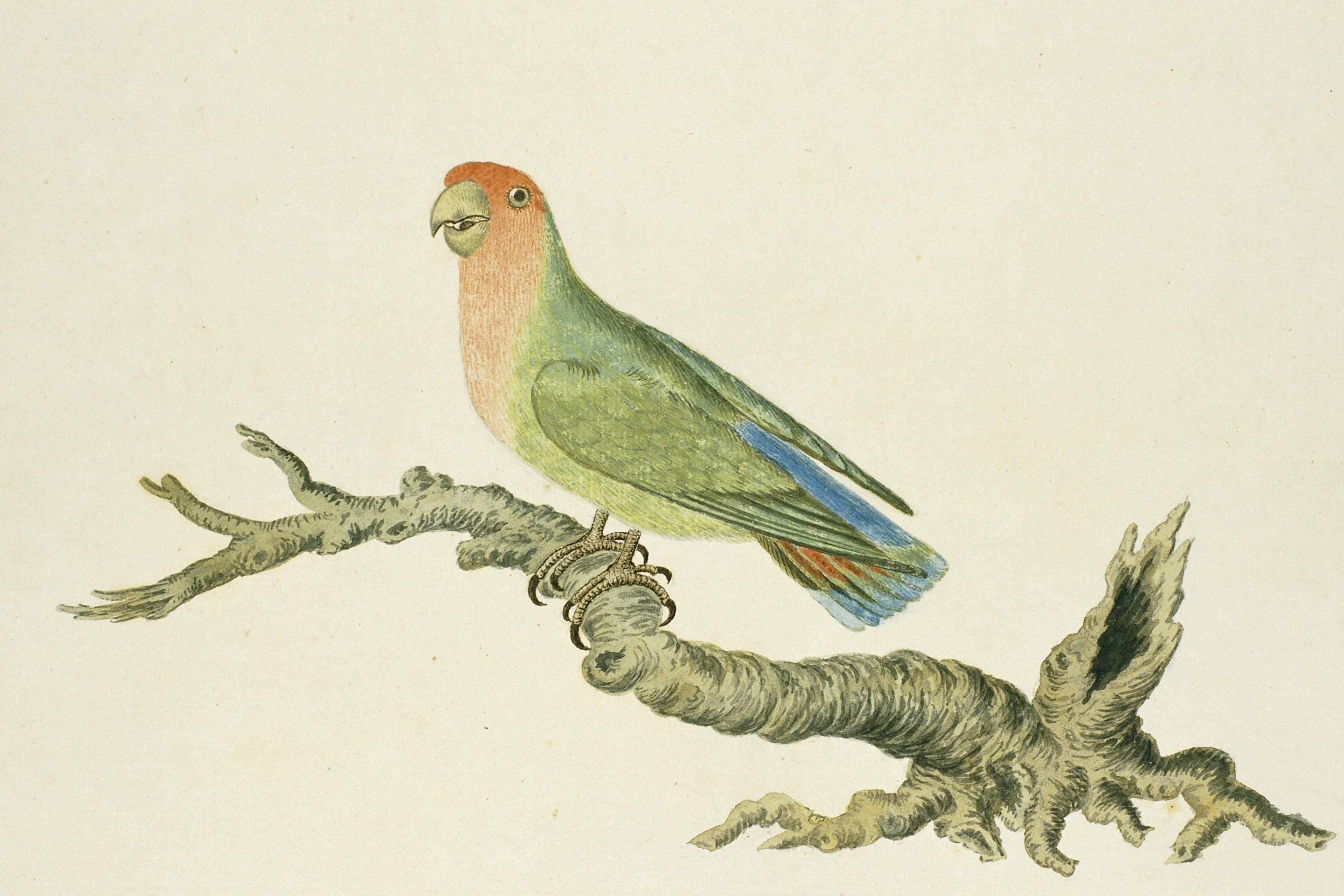
Illustration of a colourful green and red parrot perched on a branch, against a plain beige background.

Imagine trying to describe everything you see, think or feel with only 120-140 words. That’s the challenge posed by Toki Pona, a constructed language developed by Sonja Lang in an effort to simplify her thoughts while struggling with depression.

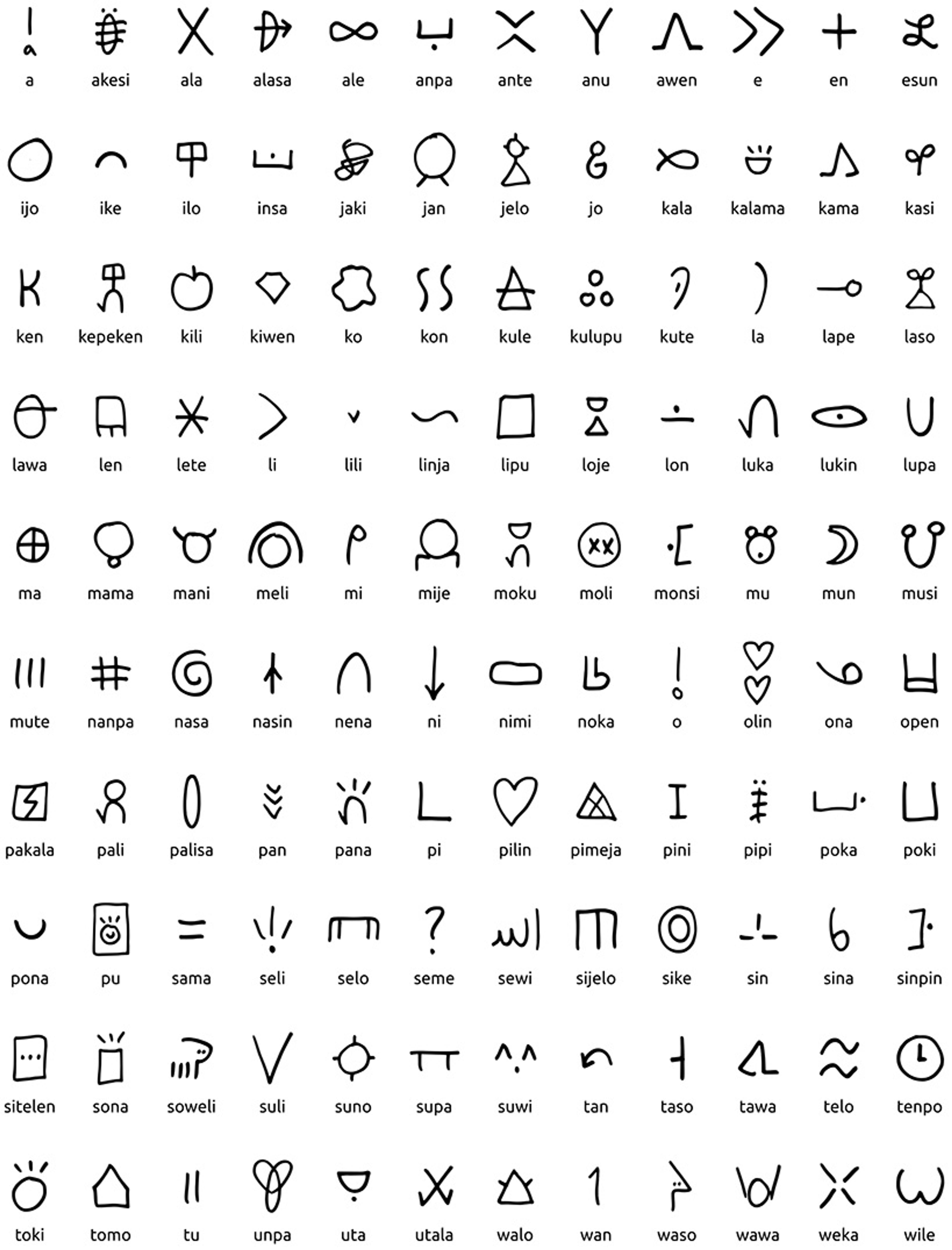
At first, my appreciation for the language was due to its impossibly cute script:

Image showing a chart of Toki Pona symbols with corresponding words, arranged in a grid.

But once I really thought about its tiny lexicon, I wondered about metaphor. Every word is expected to stretch: lete means ‘cold’, ‘raw’ or ‘to cool down’. Kili is ‘fruit’, ‘vegetable’ or ‘mushroom’. The question is what happens to the literal-figurative distinction with such underspecification?

Consider two metaphors, drawn from the poets Emily Dickinson and W S Merwin:

1. Hope is the thing with feathers.
2. Everything I do is stitched with your absence.

Now rendered in Toki Pona (translated by my spouse):

1. Wile li ijo pi selo waso – literally: ‘Desire is a thing with bird skin.’
Wile covers want, need, desire, longing, and will. Bird skin is more descriptive than metaphorical.
2. Weka sina li kama lon insa pi pali ale mi – literally: ‘Your absence enters into all my actions.’
Spatialisation echoes the joining effect of stitching, but the translation lessens the metaphorical feel.

In English, metaphor stands out against a background of literalness, a departure from a more ‘default’ use of language. In Toki Pona, the literal-figurative distinction forms a spectrum, since words are always stretched to specify meaning. That shifts the burden of sense-making from writer to reader. In English, metaphor is a writer’s flourish. In Toki Pona, resolving tension falls heavily on the reader.

I used to think alongside Ludwig Wittgenstein that the limit of my language is the limit of my thought. But Toki Pona makes me rethink that. Minimalism in language doesn’t reflect a minimalist world. Meaning-making is inevitable, and constraint simply shifts where the complexity lies.

by Hannah H Kim

FIND OUT MORE

Check out the official website of Toki Pona if you would like to explore the language yourself.

In the Aeon Essay ‘Metaphors Make the World’ (2024), Benjamin Santos Genta illuminates the metaphors that form the texture of our thought.


I’m trying a different approach to listening

Two colourful birds on a branch one with wings spread against a blurred background.

Lately, I’ve been trying to be a better listener by using Carl Rogers’s technique of ‘unconditional positive regard’ (UPR), an idea I learned about on a recent psychology course. UPR refers to nonjudgmental acceptance of, and care for, a person – regardless of whether you agree with the things they say, think and do. It doesn’t suggest that you ignore or permit harmful behaviour, only that an individual should not have conditions they need to meet for them to be worthy of warmth and support.

When I first heard about UPR, it struck me that one reason it might be so powerful is that we very rarely come across this nonjudgmental approach in our daily lives. From socialising to contributing in meetings, it can often feel as though we’re being assessed in various ways. I thought about how comforting it is when you know you’re being held in a positive regard that isn’t going to waver, even if you have an off day or make an error – and whether this was something I could more intentionally foster for the people around me.

In practice, this has meant resisting the urge to jump in with advice, which I’ve noticed is often infused with judgment, and attempting to listen without necessarily looking for a solution. It’s revealed more of my own biases and thought patterns – such as the way I sometimes default to ‘I would/wouldn’t have done X’, rather than understanding where the other person is coming from. It’s meant asking more questions and being increasingly mindful of my nonverbal communication, such as avoiding facial expressions that communicate surprise or disagreement. Granted, I fail every day to uphold the aims of UPR, but the process of attempting it has increased my capacity for compassion – and a happy side-effect is that I seem to judge myself a little less now, too.

by Molly Williamson

FIND OUT MORE

The Psyche Idea ‘Why Listening Well Can Make Disagreements Less Damaging’ (2024) by Guy Itzchakov provides a summary of research showing how high-quality listening, incorporating a nonjudgmental approach, can reduce extremist and prejudiced views, encouraging more nuanced and complex beliefs.

For a reflective personal account on using Rogers’s theories to become a better listener, try the Aeon Essay ‘The Art of Listening’ (2022) by M M Owen.


NOTE TO SELFWORK AND VOCATION

Are you saying ‘thank you’ too effusively?

A group of office workers turned to face a colleague, clapping and smiling, in a modern meeting room setting.

I was taken aback a few years ago when an article went viral admonishing its readers for sending so many ‘thank you’ emails – we’re all struggling with overflowing inboxes, it claimed, and insisting on replying ‘thank you’ all the time, while polite, just adds to the collective burden. Guilty as charged, I thought at the time.

According to a recent paper, there’s another reason to go easy on your gratitude. In the words of the research team led by Kristin Laurin at the University of British Columbia, saying ‘thank you’ too intensely could have ‘potential negative consequences’ for your ‘impression-management goals’. In short, it could make you seem like less of a boss.

The researchers came to their conclusion after presenting hundreds of participants with examples of exchanges between a helper and a thanker. Some of these were fictional vignettes, others were real-life workplace exchanges. Gratitude expressions ranged from the to-the-point ‘Thanks’ to the much more effusive ‘Thank you so much for taking your time to do this for me. I’m incredibly grateful. You have no idea how much I appreciate it. Thank you again.’

Participants rated more effusive thankers as being lower in status and lower in power (that is, having less control over resources and decision-making), relative to helpers. In the real-world examples, this was specifically the case when the message of thanks dominated, rather than being embedded in a longer message.

Expressing gratitude has many benefits – it helps us all get along, among other things – but Laurin and her team said their work shows being too effusive could have unintended consequences. If you’re an agreeable person but you also have ambitions for getting ahead, it might be worth pausing before expressing your next thankful message.

by Christian Jarrett

FIND OUT MORE

An analysis by the energy company Ovo claimed that ‘thank you’ emails are bad for the environment and that if British adults each sent one fewer of these emails each day, we would save more than 16,433 tonnes of carbon a year.

For another nuanced take on gratitude, check out the Psyche Idea ‘True Gratitude is a Communal Emotion, Not a Wellness Practice’ (2020) by Michal Zechariah.

Explore more

Photo of a toy sheep peeking out of an open yellow plastic capsule, set against a light blue background.

The pleasure in not understanding a language can be awesome

From foreign speech to unfamiliar script, not understanding a language can be an awesome way to understand otherness

by Keith Kahn-Harris

Photo of two women and a man arguing animatedly in a crowded outdoor setting with trees in the background.

Argue better by signalling your receptiveness with these words

All too often disagreements spiral into conflict. Prevent that happening by signalling your receptiveness with these words

by Michael Yeomans

Illustration of a colourful green and red parrot perched on a branch, against a plain beige background.

What I found in one of the tiniest languages

The great complexity and extraordinary simplicity of a constructed language with no more than 140 words

by Hannah H Kim

Photo of a person walking past a historic building with greenery and flowers in the background.

Fitting in is human: forcing someone to fit in is oppression

We’re all cultural code-switchers, altering how we present ourselves to fit into the world. For some, it’s a losing game

by Arianna Falbo

Black and white photo of a woman at a desk with a typewriter and a phone, deep in thought, holding a pen to her cheek.

Assertiveness is a virtue that anyone can develop with practice

You can’t stop people making demands on your time and energy, but you can develop assertiveness skills to protect yourself

by Rebecca Roache

Photo of an ancient stone relief depicting four figures in draped garments with expressive faces, shown in close-up.

How do good conversations work? Philosophy has something to say

The idea of what makes for a successful conversation is always tricky, and has always been contested by philosophers

by Stephanie Ross

Photo of two people sitting on a park bench, one with their arm around the other, surrounded by grass and fallen petals.

Why that hard conversation will probably go better than you think

If you’ve delayed raising a touchy issue, fearing it will backfire, new research could give you the confidence you need

by Matt Huston

Photo of a cafe interior with a person working on a laptop by a window, open door and street view with bicycle outside.

How temptation works, and why it nearly stopped me writing this

Temptation can be sneaky – a rationalising voice that subtly undermines your resolve. But there are ways to outsmart it

by John Schwenkler